
Agent Performance Engineering
You have already invested time, money and internal credibility in an agent. It handles some cases well and fails unpredictably on others, and nobody can prove whether the changes are helping. Deployment slips and experienced people still do the work by hand.
We benchmark the agent against real cases, find what is holding it back, fix the highest-impact problems and prove the improvement. The result is a production-ready system your team can deploy with confidence, including the right checks and human review for cases that should not be fully automated.
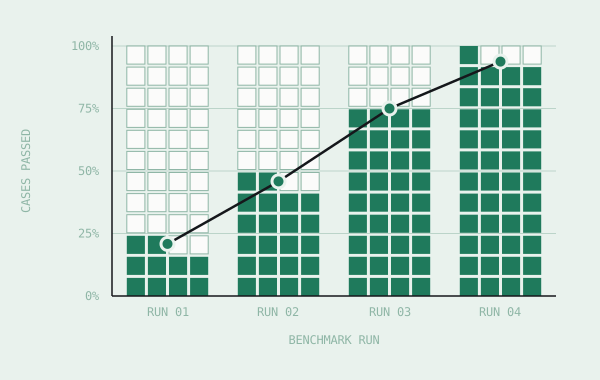
Measure how it performs today
We test the agent against the cases it actually has to handle, using real inputs from your documents, systems and logs. We work with the people who do the job today to define what a good result looks like, including the difficult cases and important exceptions.
Find the real cause
A failing agent is not necessarily a model or prompt problem. The issue may be in the source data, document extraction, the information it retrieves, the tools it uses, the workflow around it, or a business rule nobody wrote down. Most of this is context engineering rather than prompt tuning. We isolate the cause before changing anything.
Fix the problems that block deployment
Not every failure deserves the same engineering effort. We prioritise by how often a problem happens, the risk it creates, and whether it stops the agent delivering value. That often means work on the data and extraction layer itself, not only the agent sitting on top of it, which is the part of the stack we came from. We preserve what already works.
Design the right human handoff
Production-ready does not have to mean fully autonomous. We design checks, confidence thresholds and escalation routes so that complex or uncertain cases reach a person with the right context. The agent handles what it can do reliably and your experts focus on the cases that need them.
Prove the improvement
Every change is tested against the same benchmark. Performance becomes something the business can see rather than an impression from a good demonstration. The result is evidence that the agent is ready for its defined role, with its limits understood.
You have already built something. You do not need convincing that AI is interesting. You need to know whether this agent can be trusted with real work and what it will take to deploy it successfully.
Teams come to us when a prototype works but not consistently enough to deploy, when an agent performs well in demonstrations but struggles on real cases, or when changes keep altering the output without producing measurable improvement.
This matters most where mistakes are expensive and expert time is scarce, including insurance, financial services and complex operational workflows.
They handled the full stack — optimised our Postgres layer, added proper tracing and evals, and set up monitoring so we could trust it in production. The result is a data agent that's accurate, fast, observable, and delivering consistent analysis across our customer base.
- 01
A clear baseline for how the agent performs on real work today.
- 02
An explanation of which failures matter and what is causing them.
- 03
A production-ready agent with the right automation, checks and human review.
- 04
An evaluation practice your team can use for every future change.
>_ Other services
>_ 02
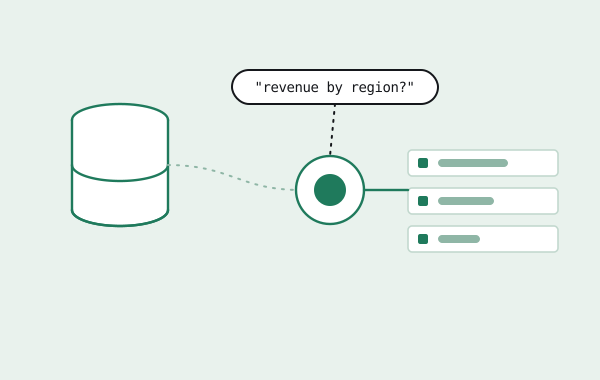
Data Agents
Ask your business questions in plain language, grounded in the data your team already trusts.
>_ 03
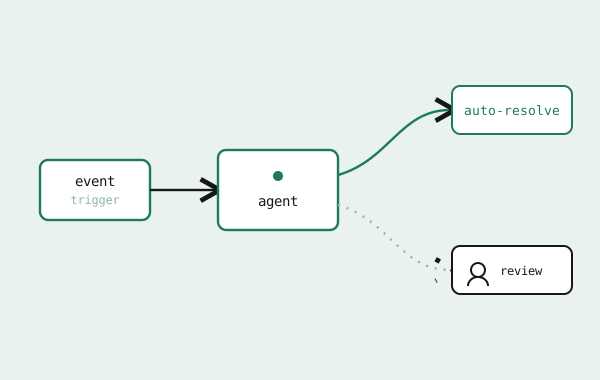
Workflow Agents
Move routine work across teams, systems, and checks without adding more manual handoffs.
>_ 04
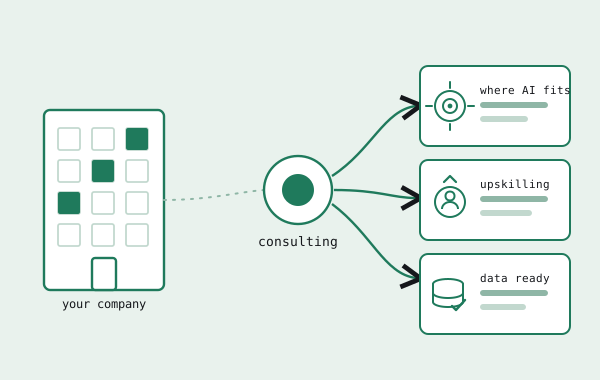
Consulting
Find the right AI starting point before you commit to building the wrong thing.
Get your team's week back
Tell us about the admin that eats into your team's week, and we'll work with you to solve it with agents.